
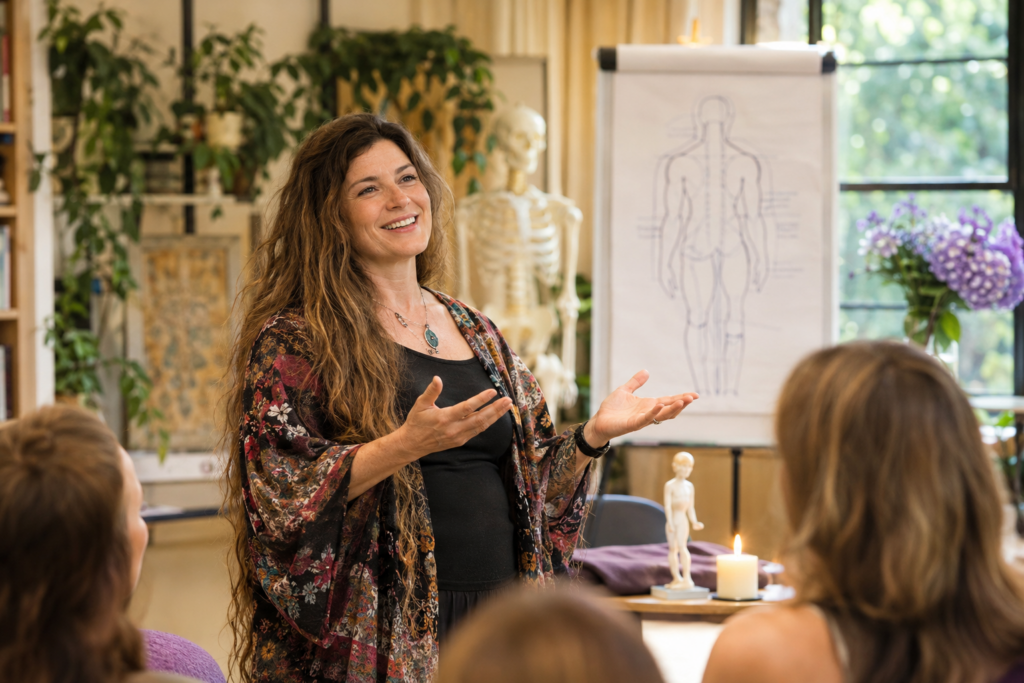
From Practitioner to Teacher: 7 Powerful Signs You’re Ready to Start Your Own Training School by Jayney Goddard, MSc, PG Dip Ed, FCMA, FRSM, President, The Complementary Medical Association
Some of the most gifted practitioners I have met over the past three decades reach a point where one-to-one work, however rewarding, no longer feels like enough. They have helped hundreds of clients. They have refined their approach through years of experience. And they have a growing sense that what they know could help far more people than they could ever see in a treatment room.
For many, the answer is teaching. When you train others in your discipline, every graduate carries your standards, your knowledge and your care out into the world. Your reach is multiplied many times over.
But how do you know whether you are truly ready to start your own training school? Being an excellent practitioner and being an excellent teacher are related, but they are not the same thing. Here are seven powerful signs that you may be ready to make the leap.
1. Moving from practitioner to teacher: people keep asking you to teach them!
Often the first sign comes from other people. Clients ask how they can learn what you do. Fellow practitioners want to know how you get such consistent results. Students on placement linger after their sessions with more questions.
When the requests keep coming, it tells you two things. First, there is demand for what you know. Second, people already see you as an authority in your field – and that trust is the foundation every successful training school is built on.
2. You can explain the “why”, not just the “how”
Experienced practitioners do much of their best work by instinct. You read a client, adapt your approach and know what to do next – often without consciously thinking about it. That fluency is a mark of real expertise, but it can make teaching harder than you might expect.
Education researchers call this the “expert blind spot”. In a well-known study of trainee teachers, Nathan and Petrosino found that those with more advanced subject knowledge were more likely to misjudge which tasks beginners would actually find difficult.1 In other words, the more you know, the easier it is to forget what it felt like not to know it.
A good test of readiness is to try explaining a core technique to someone with no background in your discipline. Can you break it into clear steps? Can you say why each step matters? Can you anticipate where a beginner will get stuck? If you can, you are already thinking like a teacher.
3. You have a rich body of real-world experience to draw on
Students learn the theory from textbooks. What they come to you for is everything the textbooks leave out: the client who did not respond as expected, the session that needed a change of plan, the case that taught you something you never forgot.
If you have built up a store of genuine case experience – the successes, the surprises and the lessons learned – you have something extraordinarily valuable to pass on. Those stories are what bring a course to life and prepare your students for the realities of practice.
4. You have developed an approach that is distinctly yours
Over the years, most outstanding practitioners develop their own way of working. Perhaps you have refined a particular protocol, combined approaches in a way that works especially well, or created a structure for consultations that clients consistently respond to.
That distinctive approach is exactly what makes a training school stand out. Prospective students have many choices, and they are drawn to teachers who offer something they cannot find anywhere else. If you can clearly describe what makes your way of working different – and why it gets results – you have the beginnings of a course worth enrolling on.
5. You love watching other people grow
Teaching asks for a different kind of generosity from practice. Your satisfaction comes less from your own results and more from seeing someone else succeed: the student who finally grasps a difficult concept, the graduate who sends you a message about their first fully booked week.
If you already find yourself mentoring newer practitioners, supporting colleagues or encouraging students – and you find it deeply fulfilling – that is a strong sign that teaching will suit you.
There is a lovely bonus, too. Teaching deepens your own mastery. Research by Fiorella and Mayer found that people who prepared to teach material, and then explained it to others, understood it more deeply than those who simply studied it for a test.2 Many teachers say that training others has made them better practitioners, and the evidence suggests they are right.
6. You are ready to think like a business owner
This is the sign that is most often overlooked. A training school is a business, and running it well involves far more than delivering great content. You will need to think about course design and assessment, pricing and payment terms, marketing and student recruitment, venues or online platforms, record keeping, data protection, insurance, and clear terms and conditions for your students.
None of this needs to be daunting, but it does need to be planned. If your practice is stable enough to give you the time and headspace to build something new – and you are excited rather than overwhelmed by the business side – you are in a strong position. In my own postgraduate training in education, one lesson stood out: great courses are designed, not improvised. The same is true of great training schools.
7. You care deeply about standards
Every graduate you train will carry your name with them. Their competence, safety and professionalism will reflect on you, on your school and on your discipline as a whole.
The best training school owners I know take this responsibility seriously. They want their students properly assessed, their case studies rigorously reviewed and their graduates genuinely ready for practice. They also want independent recognition that their courses meet a high standard – which is why so many choose to have their courses accredited by The CMA. Accreditation gives prospective students confidence, sets your school apart and shows that you are committed to excellence.
If high standards matter to you as much as reaching more people, you have exactly the right mindset to teach.
So, are you ready?
If you recognised yourself in several of these signs, it may be time to take your idea of teaching seriously. You do not need to have every answer before you begin. What you do need is a clear plan, a well-designed course and the support of people who have walked this path before.
Over more than three decades, The CMA has worked with hundreds of Training Schools across a remarkable range of disciplines. We have seen what helps a new school flourish – and what holds one back. If you are already running a Training School, we would love to help you grow. And if you are a Practitioner dreaming of teaching, we are developing something very special for you. Keep a close eye on your emails – you will be the first to hear.
In the meantime, you can find out more about Training School Membership and course accreditation with The CMA.
Reflective Practice – CPD Corner
Take 20 minutes to reflect on your own journey towards teaching. Jot down your answers – they form the basis of a valuable CPD entry.
- Your why. What draws you to teaching your discipline? Write down the difference you would most like your future graduates to make.
- The beginner’s view. Choose one technique you use every day. Break it into steps a complete beginner could follow. Which step was hardest to put into words, and why?
- Your stories. List three client cases (anonymised) that taught you something important. What would each one teach a student?
- Your signature. In two or three sentences, describe what makes your approach distinctive. Would a prospective student understand why they should learn it from you?
- The business side. Which parts of running a training school feel most comfortable to you, and which feel least familiar? Where could you find support?
- Your standards. How would you know that a graduate of your course was safe, competent and ready to practise? What assessment would you need to be confident?
One change I will make as a result of this reflection:
______________________________________________
CPD tip: Log the time you spent reading this article and completing these prompts in your CPD record, along with your answers and your “one change”. Return to it in three months and note what progress you have made.
References
- Nathan, M. J., & Petrosino, A. (2003). Expert blind spot among preservice teachers. American Educational Research Journal, 40(4), 905–928. https://doi.org/10.3102/00028312040004905
- Fiorella, L., & Mayer, R. E. (2013). The relative benefits of learning by teaching and teaching expectancy. Contemporary Educational Psychology, 38(4), 281–288. https://doi.org/10.1016/j.cedpsych.2013.06.001
About the Author
Jayney Goddard MSc, PG Dip Ed, FCMA, FRSM is the Founder and President of The Complementary Medical Association (The CMA), the world’s leading professional body for complementary medicine. With more than three decades at the forefront of complementary and integrative healthcare, Jayney has dedicated her career to raising professional standards across the sector and to championing rigorous, evidence-based natural approaches to health and longevity. She is the author of several best-sellers, including Rewind Your Body Clock – the Complete Natural Guide to a Happier, Healthier, Younger You (Watkins/Penguin Random House), which debuted on the Amazon charts at No. 1 among ALL books on the platform. Jayney is a sought-after teacher, international speaker and a passionate advocate for the safe, ethical integration of complementary medicine within mainstream healthcare. Through The CMA, she supports a global community of Practitioners, Fellows, and Approved Suppliers committed to the very highest standards of practice.